Quick Summary
In the fast-evolving world of online retail, leveraging artificial intelligence (AI) can unlock significant advantages — from deeper customer insights and personalised experiences to smarter operations and higher profitability. This article guides you through the why, the what, and the how of applying AI in eCommerce: why it matters, which functions it improves (chatbots, recommendations, dynamic pricing, inventory forecasting), and step-by-step advice to get started responsibly and effectively.
Table of Contents
Artificial intelligence is no longer a “nice-to-have” in eCommerce—it has become the foundation of how modern online businesses operate. From personalized shopping experiences to automated customer support and predictive inventory planning, AI enables brands to work smarter, scale faster, and deliver better results.
Today, successful eCommerce businesses rely on AI to analyze massive amounts of customer data, automate decision-making, and create highly tailored experiences. This leads to improved engagement, higher conversions, and stronger customer loyalty.
This guide explores how to use AI in eCommerce in a practical, results-driven way, helping you understand not just what AI can do but also how to implement it effectively.
What AI in eCommerce Really Means
AI in eCommerce refers to the use of advanced technologies such as machine learning, natural language processing, and predictive analytics to improve business operations and customer experiences.
Instead of relying on manual processes, AI systems learn from customer interactions, browsing behavior, and purchase history to make intelligent decisions in real time. This allows businesses to understand their customers better, automate repetitive workflows, and predict future demand with greater accuracy.
At its core, AI transforms eCommerce from reactive decision-making to proactive, data-driven strategy.
The 10 Most Powerful Ways to Use AI in eCommerce
1. Hyper-Personalized Product Recommendations
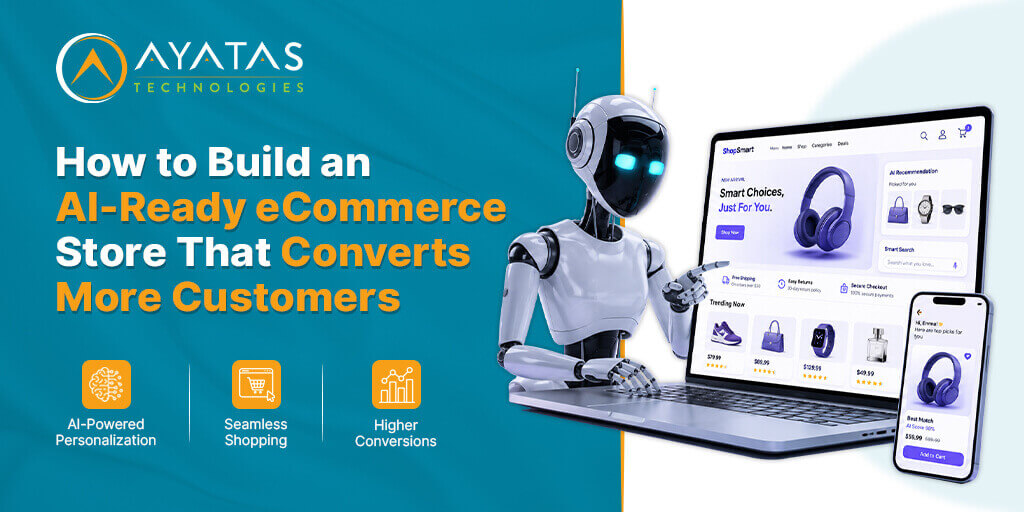
AI enables businesses to deliver highly personalized product recommendations by analyzing customer behavior such as browsing patterns, purchase history, and interactions across the website. Rather than offering generic “related products,” AI systems tailor suggestions to each shopper.
This level of personalization significantly improves the shopping experience, making it easier for customers to discover relevant products. As a result, businesses often see higher conversion rates, increased average order value, and improved customer retention.
2. AI Chatbots and Virtual Shopping Assistants
AI-powered chatbots function as round-the-clock customer service and sales representatives. They can instantly respond to customer inquiries, recommend products, assist with order tracking, and even handle returns.
These virtual assistants improve customer satisfaction by providing immediate support while also reducing operational costs. Additionally, they help drive sales by guiding customers through their buying journey and offering personalized suggestions in real time.
3. AI-Generated Product Content and Marketing
Generative AI has transformed how eCommerce businesses create content. It can automatically generate product descriptions, marketing copy, email campaigns, and even SEO-focused blog content. This allows businesses to maintain consistency across large product catalogs while significantly reducing manual effort. Moreover, AI-generated content can be tailored to different customer segments, increasing relevance and engagement.
4. Predictive Inventory Management
AI plays a crucial role in optimizing inventory management by analyzing historical sales data, seasonal trends, and customer demand patterns. Based on this data, AI can accurately forecast future inventory needs. This helps businesses avoid stockouts and overstocking, both of which can negatively impact revenue and customer satisfaction. By improving inventory accuracy, companies can also optimize their supply chain and reduce operational costs.
5. Dynamic Pricing Optimization
With AI, pricing is no longer static. Instead, it becomes dynamic and responsive to real-time factors such as market demand, competitor pricing, customer behavior, and inventory levels.
This allows businesses to maximize profitability while remaining competitive. AI-driven pricing strategies ensure that products are always priced optimally based on current market conditions.
6. Smart Search and Visual Discovery
AI-powered search engines go beyond simple keyword matching by understanding user intent. They provide more accurate search results, offer autocomplete suggestions, and even enable visual search capabilities where customers can upload images to find similar products.
This significantly reduces friction in the buying process, helping customers find what they are looking for quickly and easily, which ultimately leads to higher conversions.
7. Customer Segmentation and Targeting
AI automatically segments customers based on their behavior, preferences, and purchasing patterns. This allows businesses to create highly targeted marketing campaigns that resonate with specific audience groups.
By delivering personalized messages, offers, and experiences, businesses can improve marketing effectiveness, increase engagement, and reduce wasted advertising spend.
8. Fraud Detection and Risk Management
AI enhances security by identifying unusual patterns and detecting fraudulent activities in real time. It analyzes transactions and user behavior to flag suspicious activity before it becomes a problem. This not only protects businesses from financial losses but also ensures a safer shopping experience for customers, building trust and credibility.
9. Automated Customer Retention and Lifecycle Marketing
AI helps businesses retain customers by analyzing where they are in their buying journey and triggering personalized interactions. For example, it can send reminders for abandoned carts, suggest replenishment for frequently purchased items, or offer loyalty rewards at the right time. This level of automation ensures consistent engagement with customers, increasing lifetime value and strengthening brand loyalty.
10. AI Analytics and Business Intelligence
AI-driven analytics tools convert complex data into actionable insights. They help businesses identify trends, predict customer behavior, and evaluate campaign performance.
This enables faster and more informed decision-making, allowing businesses to adapt quickly to changing market conditions and stay ahead of competitors.
Types of AI Used in eCommerce
Several types of AI technologies power eCommerce systems. Predictive AI focuses on analyzing historical data to forecast future outcomes, making it essential for demand forecasting, pricing strategies, and customer segmentation.
Generative AI is used to create new content, such as product descriptions, advertisements, and chatbot responses, helping businesses scale their content production efficiently.
Conversational AI powers chatbots and voice assistants, enabling real-time communication with customers in a natural and engaging way.
Emerging technologies like agentic AI are beginning to take automation further by allowing systems to make decisions and take actions independently, representing the next evolution of intelligent commerce.
Step-by-Step: How to Implement AI in Your eCommerce Business
The first step in implementing AI is ensuring that your data is clean, structured, and centralized. AI systems rely heavily on high-quality data, so having a well-organized product catalog and customer database is essential.
Once your data is ready, the next step is to identify high-impact use cases that can deliver quick results. Starting with areas like product recommendations, chatbots, or email automation is often the most effective approach.
Choosing the right tools is also critical. It is important to select AI solutions specifically designed for eCommerce, as they are better suited to handle retail-specific challenges and workflows.
Instead of trying to implement everything at once, businesses should start with a small pilot project, measure its performance, and gradually scale their AI initiatives based on proven results.
Finally, it is important to remember that AI works best when combined with human expertise. While AI can handle automation and data analysis, human creativity and strategic thinking remain essential.
Benefits of Using AI in eCommerce
When implemented correctly, AI can significantly improve business performance. It enhances customer experiences through personalization, reduces operational costs by automating repetitive tasks, and enables smarter decision-making through data analysis.
AI also improves inventory management and pricing strategies, helping businesses operate more efficiently while increasing profitability. Ultimately, it allows companies to scale their operations without compromising quality.
Future of AI in eCommerce (2026 and Beyond)
The future of AI in eCommerce is moving toward more autonomous and intelligent systems. AI will not only recommend products but also make decisions and execute actions on behalf of businesses and customers.
At the same time, the focus will shift toward seamless, invisible AI experiences that operate in the background while delivering highly personalized interactions.
As technology continues to evolve, businesses that embrace AI early and strategically will gain a significant competitive advantage.
Conclusion
AI is no longer optional in eCommerce—it is a necessity for growth and competitiveness. Businesses that successfully integrate AI into their operations can create more personalized experiences, automate complex processes, and make smarter decisions.
Making data-driven strategic decisions and expanding your business much more quickly can be made possible by integrating artificial intelligence into your eCommerce business. Consult an eCommerce solution expert if your business requires assistance navigating the opportunities that AI provides to eCommerce or integrating AI with the present strategy, tools, and platform. Our team at Ayatas Technologies has professionals with global expertise who can help you provide a unique eCommerce solution. Do not hesitate to contact us for a FREE consultation about eCommerce.