Table of Contents
Whether you’re building an eCommerce store, a SaaS platform, a marketplace, or a mobile application, choosing the right payment gateway API can make or break your customer experience. Today’s online shoppers expect secure, lightning-fast, and frictionless checkout experiences. If your payment process is slow or complicated, customers are likely to abandon their carts before completing a purchase.
Payment APIs have evolved far beyond simply accepting credit cards. Modern gateways now support digital wallets, Buy Now Pay Later (BNPL), recurring billing, subscriptions, fraud prevention, tokenization, multi-currency payments, AI-powered fraud detection, and hundreds of local payment methods. Businesses can now integrate powerful payment capabilities into their applications using REST APIs, SDKs, and webhooks while maintaining compliance with global security standards like PCI DSS.
According to recent industry reports, developer-friendly platforms such as Stripe, Adyen, Checkout.com, and PayPal continue to dominate the API ecosystem because of their comprehensive documentation, extensive SDK support, and global payment infrastructure. As cross-border commerce continues to grow, selecting a scalable payment API has become a strategic business decision rather than simply a technical requirement.
What Is a Payment Gateway API
A payment gateway API acts as the secure communication bridge between your website or mobile application and the financial institutions responsible for processing customer payments. Instead of manually transferring payment information between systems, developers use APIs to automate the entire transaction lifecycle—from collecting payment details to authorizing transactions, detecting fraud, processing refunds, and sending payment confirmations. Modern APIs typically use REST architecture, JSON responses, OAuth authentication, and webhook notifications, making them easy to integrate into virtually any technology stack.
Today’s payment APIs also support advanced capabilities that extend beyond simple card payments. Businesses can accept Apple Pay, Google Pay, bank transfers, local payment methods, cryptocurrency (where supported), and subscription billing through a unified integration. This flexibility allows merchants to deliver a localized checkout experience regardless of where their customers are located. As global eCommerce continues expanding, businesses increasingly rely on API-first payment platforms to improve customer satisfaction, reduce cart abandonment, and simplify financial operations.
Why API-Based Payment Integrations Matter
API-driven payment gateways provide significant advantages over traditional hosted payment systems. They give developers complete control over the checkout experience while maintaining strong security standards. Instead of redirecting users to external payment pages, APIs allow payments to be processed directly within websites and applications, creating a seamless user journey that improves trust and conversion rates.
Businesses also benefit from automation across payment workflows. Subscription billing, recurring payments, invoice generation, refunds, payment reconciliation, and fraud monitoring can all be managed programmatically. This reduces operational costs while enabling finance teams to focus on growth rather than manual administrative tasks. For startups, APIs provide the flexibility to launch quickly and scale efficiently. For enterprises, they offer sophisticated capabilities such as multi-currency settlements, marketplace payouts, and omnichannel payment orchestration, making them essential components of modern digital commerce platforms.
Key Features to Look for in a Payment Gateway API
Choosing a payment API involves much more than comparing transaction fees. Security should always be the highest priority. Look for providers that offer PCI DSS compliance, tokenization, encryption, 3D Secure authentication, and AI-driven fraud detection. These features protect customer information while minimizing chargebacks and fraudulent transactions.
Developer experience is equally important. The best payment APIs provide comprehensive documentation, SDKs for popular programming languages, sandbox environments, detailed error handling, webhook support, and responsive technical support. Global businesses should also evaluate supported currencies, local payment methods, settlement speed, recurring billing capabilities, reporting tools, analytics dashboards, and uptime guarantees. A well-designed payment API reduces development time while allowing businesses to adapt quickly as customer payment preferences evolve.
Best Payment Gateway API Integrations in 2026
Selecting the right payment gateway API depends on your business model, target audience, geographic reach, and technical requirements. While many providers offer similar core payment processing capabilities, they differ significantly in terms of developer experience, supported payment methods, settlement times, fraud prevention, pricing flexibility, and scalability. Some platforms are designed primarily for startups and SaaS businesses, while others excel at serving large enterprises processing millions of transactions every month.
Below are the leading payment gateway APIs that continue to dominate the market in 2026.
Stripe API
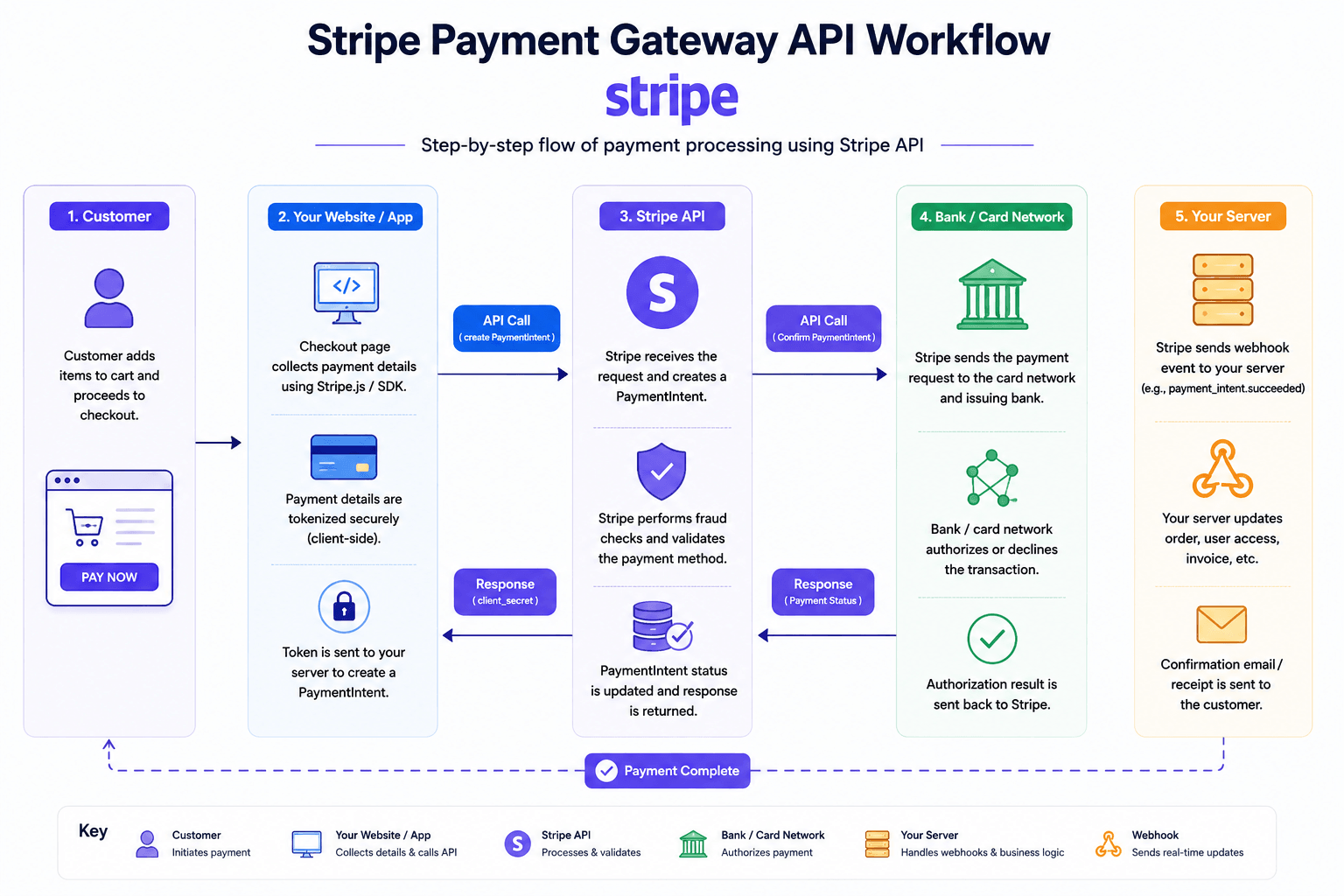
Stripe remains the gold standard for developers thanks to its API-first architecture and exceptional documentation. It supports over 135 currencies, numerous local payment methods, digital wallets, subscriptions, invoicing, marketplace payments, and advanced financial services through a single integration.
One of Stripe’s biggest strengths is its developer ecosystem. Comprehensive SDKs are available for JavaScript, Python, PHP, Java, Ruby, Go, .NET, and mobile platforms. The API is RESTful, predictable, and easy to test using its sandbox environment. Webhooks enable developers to automate payment confirmations, subscription renewals, refunds, disputes, and customer notifications in real time.
Beyond payment processing, Stripe offers products such as Stripe Billing, Stripe Connect, Stripe Identity, Stripe Tax, Stripe Terminal, and Stripe Radar for AI-powered fraud detection. This extensive ecosystem allows businesses to manage almost every financial workflow through one platform. Whether you’re launching a startup or scaling an enterprise SaaS application, Stripe provides the flexibility needed to grow without constantly changing payment providers.
Best For:
- SaaS companies
- Subscription businesses
- Marketplaces
- Enterprise applications
- Global eCommerce
PayPal API
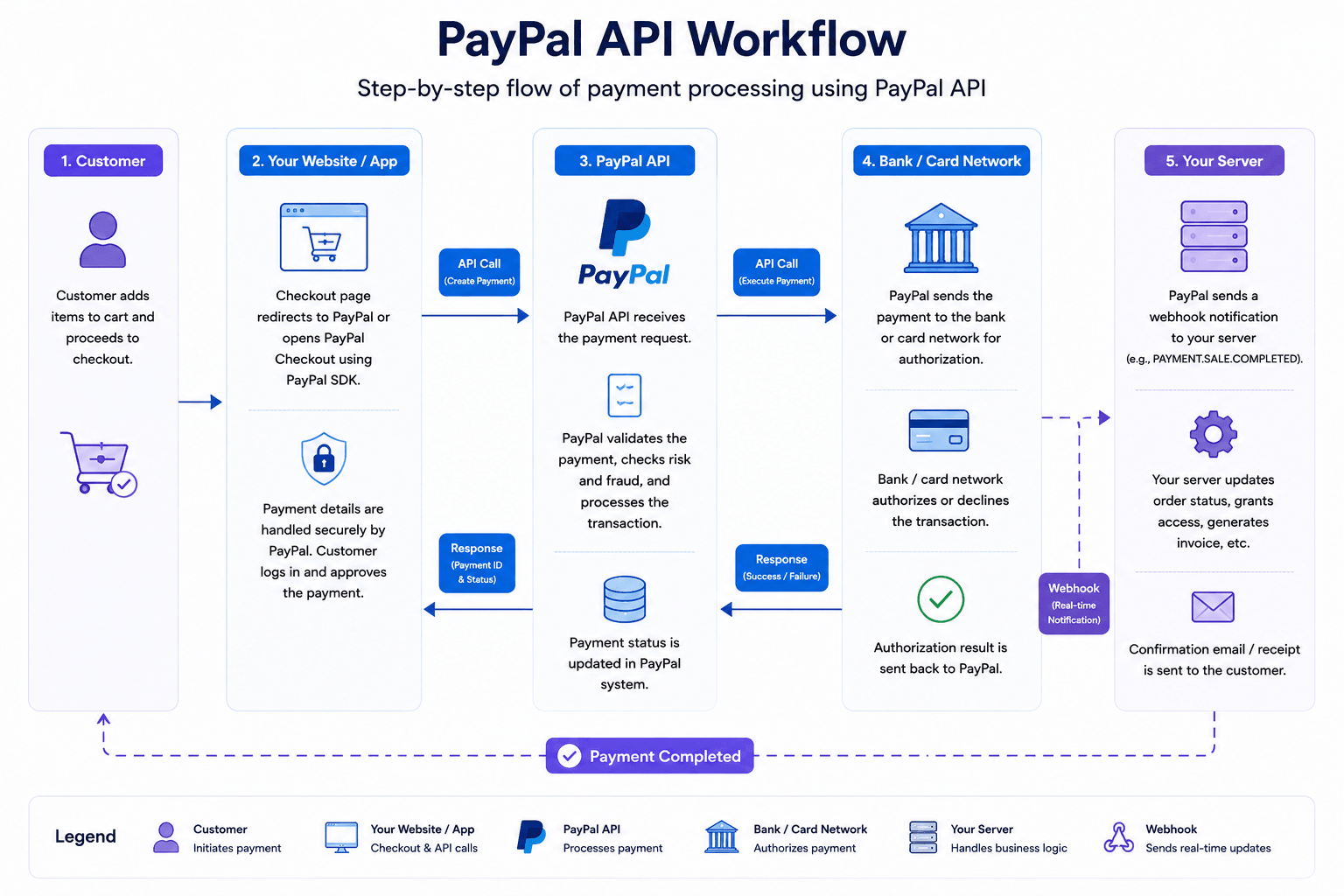
PayPal continues to be one of the world’s most recognized payment brands, making it an attractive option for businesses that want to build customer trust quickly. Millions of consumers already have PayPal accounts, allowing for faster checkouts and improved conversion rates, especially among international shoppers.
The PayPal API supports traditional PayPal payments, credit and debit cards, recurring billing, invoicing, payouts, refunds, and subscription management. Developers can integrate either hosted checkout pages for quick implementation or fully customized checkout experiences using REST APIs and JavaScript SDKs.
For businesses selling internationally, PayPal’s broad global presence is a major advantage. Customers can pay using local currencies while merchants receive settlements in their preferred currency. Combined with strong buyer protection programs and fraud monitoring, PayPal remains a reliable solution for small businesses and established enterprises alike.
Best For:
- International businesses
- Small businesses
- Digital products
- Freelancers
- Cross-border commerce
Adyen API
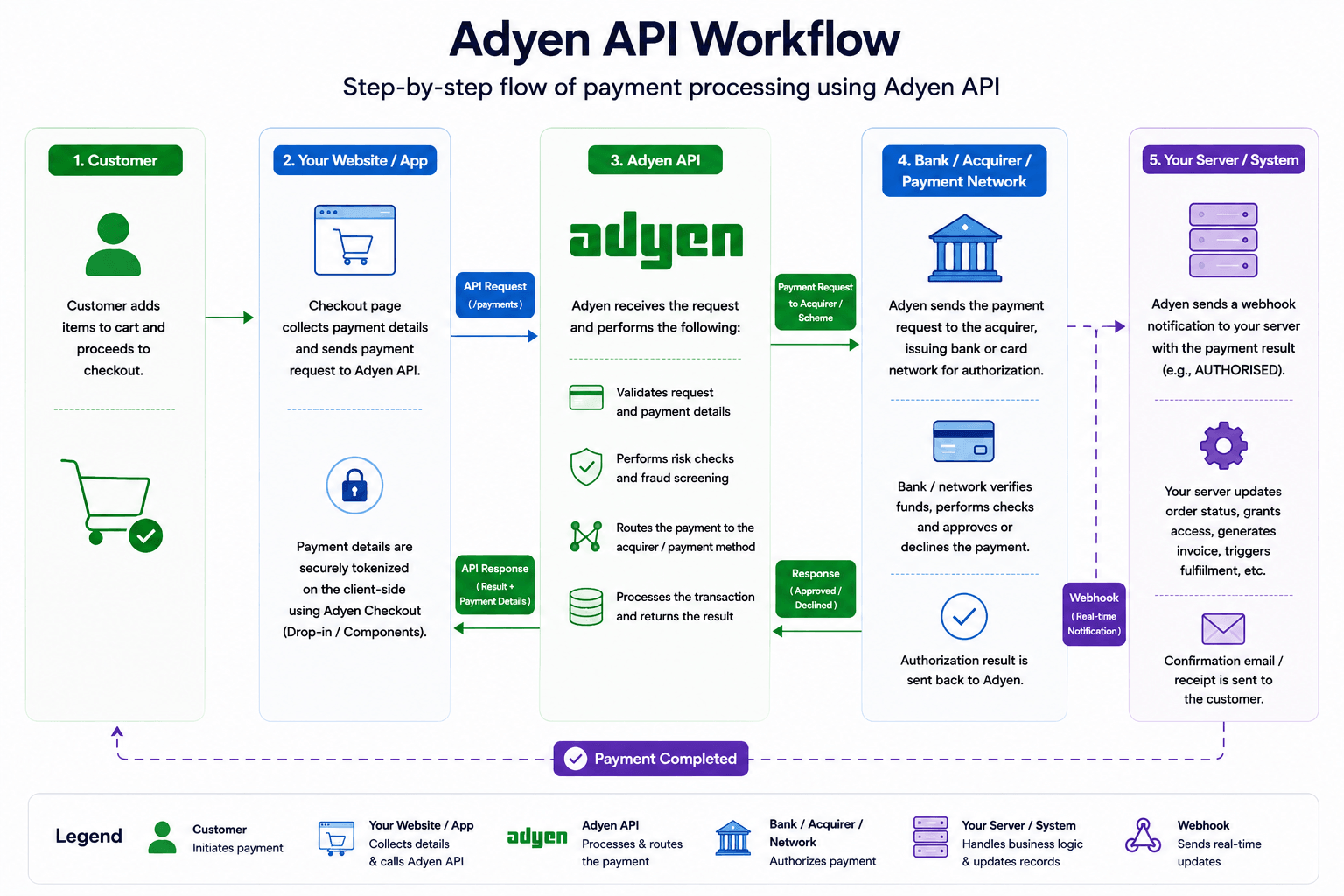
Adyen is widely recognized as one of the leading enterprise payment platforms. Rather than relying on third-party processors, Adyen operates a unified payment infrastructure that combines payment gateway services, acquiring, risk management, and analytics into one platform.
Large global companies choose Adyen because it supports hundreds of payment methods across dozens of countries while maintaining a single integration. Businesses can process online, mobile, and in-store payments using the same backend infrastructure. This unified commerce approach simplifies reporting while providing a consistent customer experience across every sales channel.
Developers benefit from robust APIs, detailed documentation, and sophisticated fraud management tools. Machine learning algorithms continuously evaluate transactions to reduce fraud while maximizing payment approval rates. Adyen also provides advanced revenue optimization features that intelligently route payments to improve authorization success.
Best For:
- Large enterprises
- Global retailers
- Omnichannel businesses
- International marketplaces
Checkout.com API
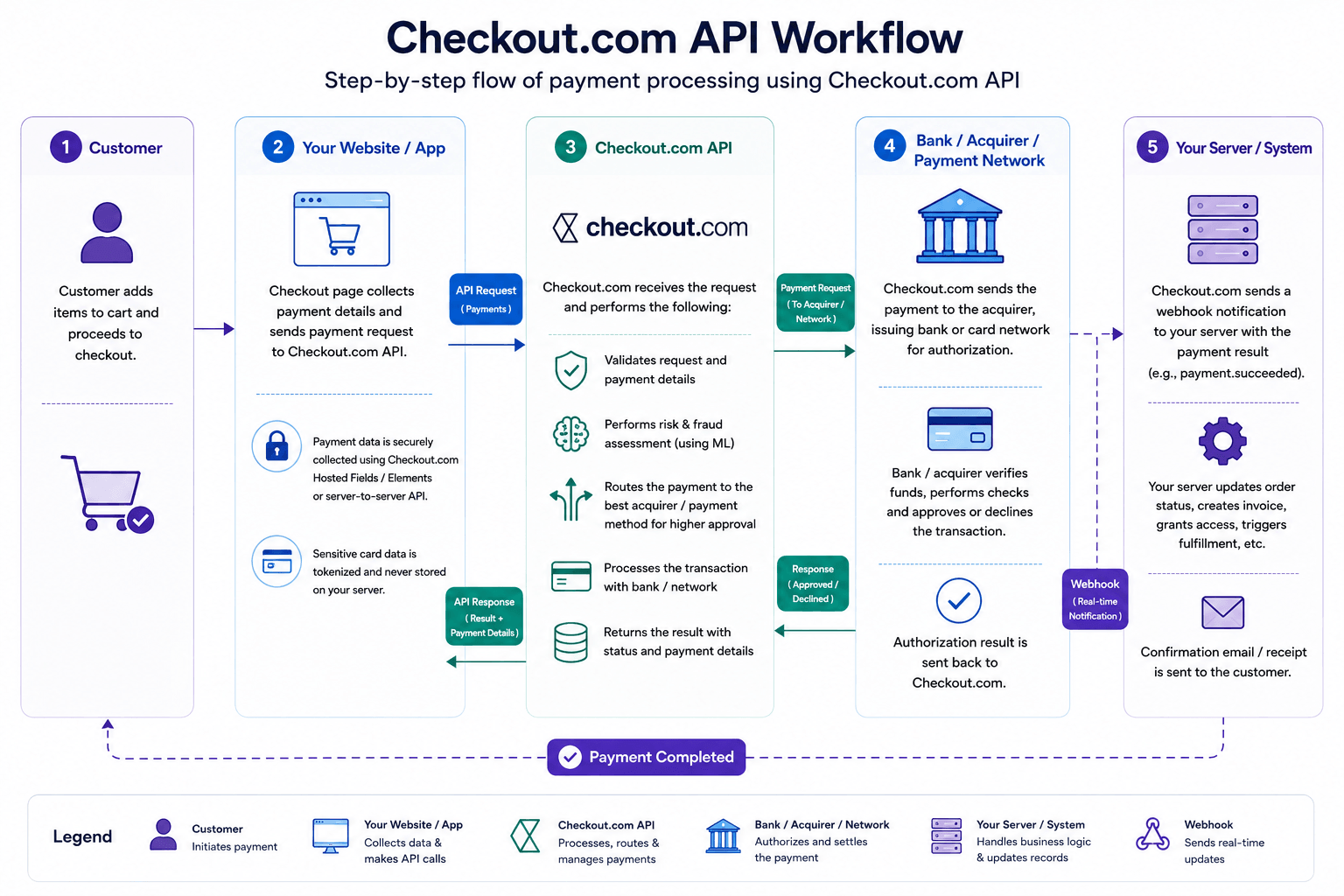
Checkout.com has become a preferred payment infrastructure provider for high-growth digital businesses. Its cloud-native architecture emphasizes payment performance, reliability, and intelligent transaction routing. Businesses benefit from faster payment processing, higher authorization rates, and detailed analytics that help optimize revenue.
The platform supports cards, digital wallets, local payment methods, recurring billing, tokenization, and advanced fraud detection. Developers appreciate its modern REST APIs, flexible SDKs, webhook support, and comprehensive testing environments. Checkout.com also provides customizable payment flows that allow businesses to create highly personalized checkout experiences.
One of Checkout.com’s biggest differentiators is its focus on enterprise-level payment optimization. Instead of simply processing transactions, it analyzes payment data to improve conversion rates and reduce unnecessary declines. This makes it particularly valuable for businesses handling large transaction volumes across multiple countries.
Best For:
- High-growth businesses
- Enterprise commerce
- International merchants
- Digital platforms
Square API
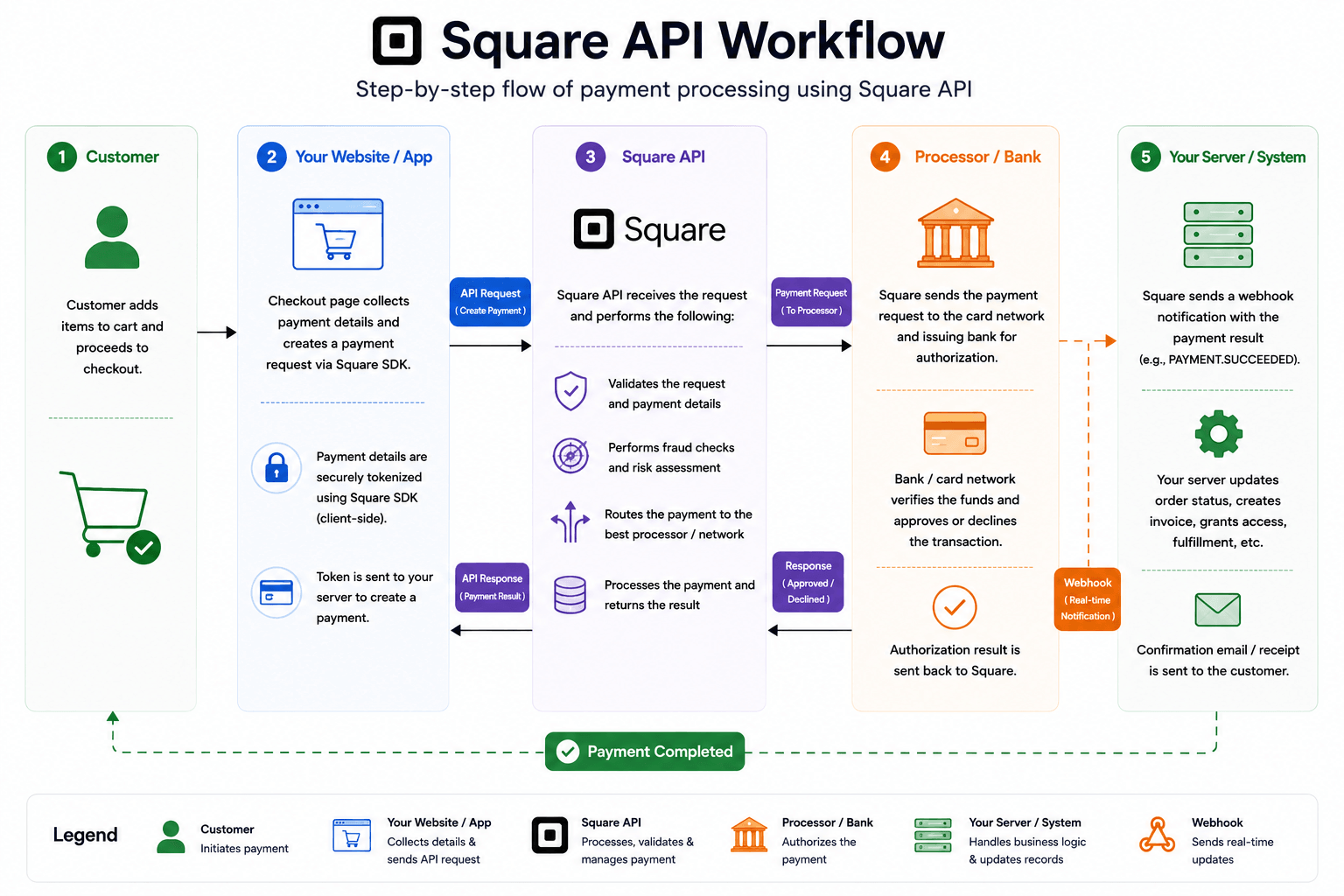
Square has evolved far beyond its original point-of-sale solution. Today, its APIs enable businesses to unify online stores, physical retail locations, inventory management, customer data, and payment processing within a single ecosystem.
Developers can integrate payment acceptance, subscriptions, invoices, customer management, loyalty programs, gift cards, and order management through Square’s APIs. The platform is especially attractive for businesses operating both online and offline because it synchronizes inventory and customer information across every sales channel automatically.
Square also offers easy onboarding, transparent pricing, and intuitive developer documentation, making it an excellent option for growing retailers and service businesses that want enterprise capabilities without enterprise complexity.
Best For:
- Retail businesses
- Restaurants
- Service providers
- Omnichannel merchants
- Small and medium-sized businesses
Razorpay API
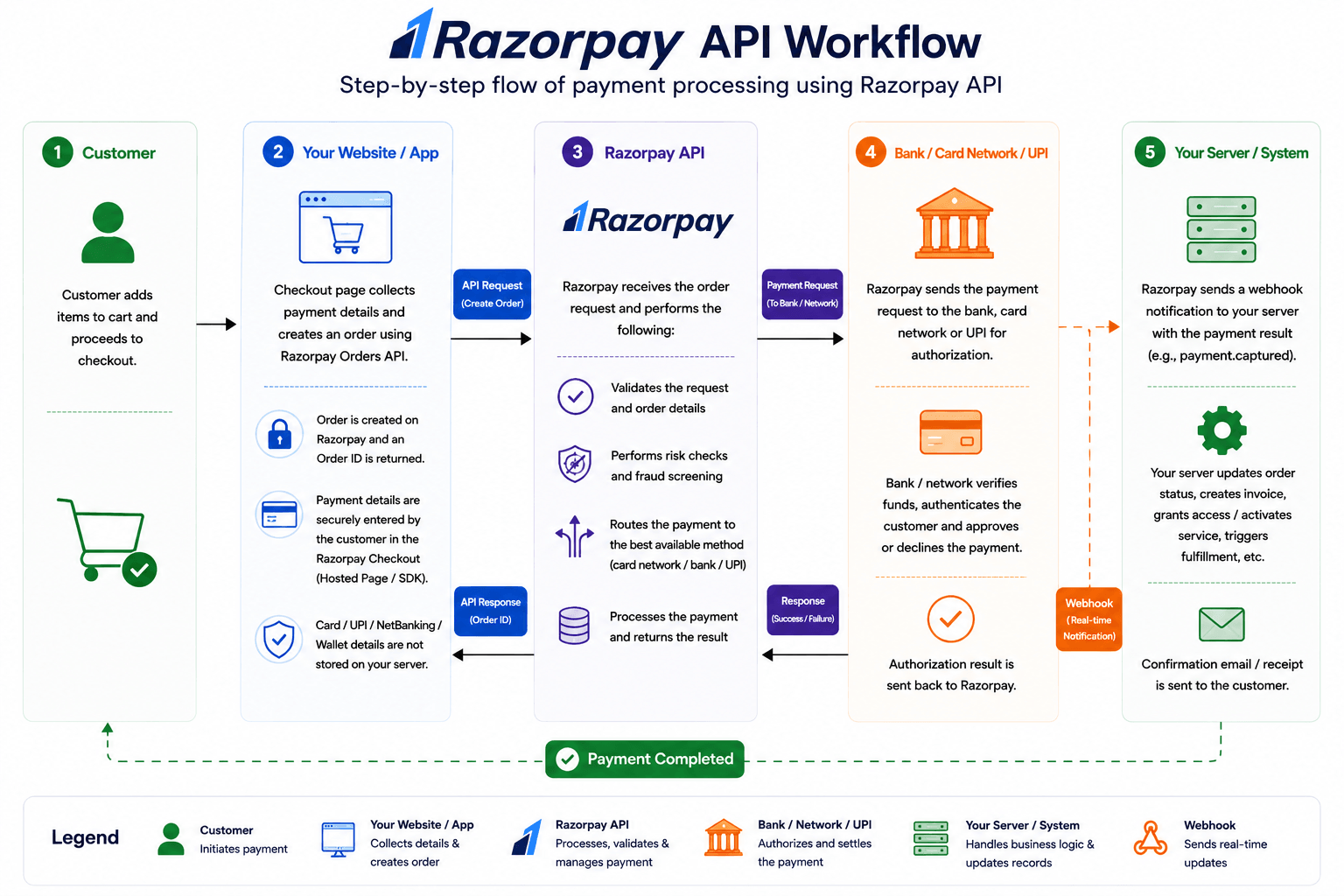
For businesses operating in India, Razorpay has become one of the most comprehensive payment gateway APIs available. Designed with Indian merchants in mind, it supports credit and debit cards, UPI, net banking, digital wallets, EMI options, recurring payments, and international transactions. This extensive payment coverage makes it an ideal solution for businesses that want to cater to diverse customer preferences without integrating multiple payment providers.
From a developer’s perspective, Razorpay offers a clean REST API, SDKs for major programming languages, webhook support, and an intuitive dashboard for monitoring transactions. Businesses can quickly implement payment links, subscriptions, invoices, QR code payments, and automated payouts using the same API ecosystem. The sandbox environment simplifies testing, allowing developers to validate payment workflows before deploying them into production.
One of Razorpay’s standout features is its business automation capabilities. In addition to payment processing, it provides solutions for payroll, vendor payouts, recurring billing, smart routing, and financial reporting. Small startups can launch quickly using pre-built checkout components, while larger organizations can build fully customized payment experiences through APIs. For companies targeting the rapidly growing Indian digital economy, Razorpay delivers excellent local payment coverage and compliance with domestic banking regulations.
Best For:
- Indian eCommerce businesses
- SaaS companies
- Educational platforms
- Subscription businesses
- Startups and SMEs
Braintree API
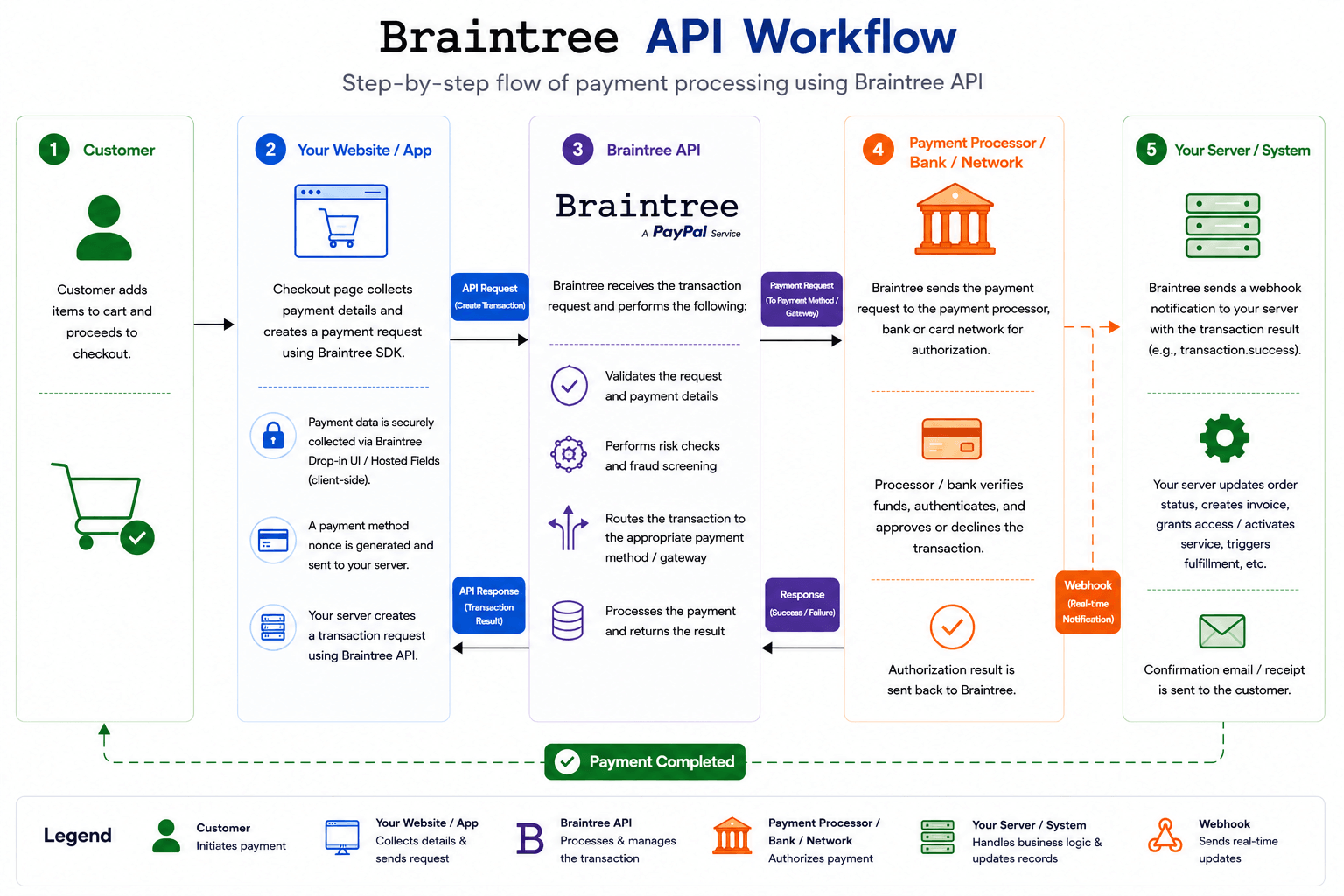
Owned by PayPal, Braintree is a developer-focused payment gateway that offers flexibility without requiring merchants to manage multiple payment integrations. It supports credit cards, PayPal, Venmo, Apple Pay, Google Pay, and numerous local payment methods through a unified API, making it a popular choice for businesses serving customers across different markets.
Braintree excels in subscription billing and recurring payments, offering built-in tokenization, secure vault storage, fraud protection, and recurring billing management. Developers appreciate its straightforward SDKs, comprehensive documentation, and transparent implementation process. Since Braintree shares infrastructure with PayPal, merchants also benefit from PayPal’s extensive global payment network while maintaining greater control over the checkout experience.
For growing SaaS businesses and mobile app developers, Braintree strikes an excellent balance between simplicity and advanced functionality. Features such as split payments, marketplace support, customer vaults, and recurring billing reduce development effort while enabling businesses to scale efficiently. If your application requires multiple payment methods under one integration, Braintree remains a compelling option.
Best For:
- SaaS platforms
- Mobile applications
- Subscription services
- Digital products
- Medium-sized businesses
GoCardless API
Unlike traditional payment gateways that focus primarily on card transactions, GoCardless specializes in bank-to-bank payments using direct debit networks. This approach significantly reduces transaction costs for businesses that process recurring payments, making it particularly attractive for subscription-based companies, membership organizations, educational institutions, and utility providers.
The GoCardless API enables developers to automate recurring billing, mandate management, payment collection, customer notifications, and reconciliation processes. Since payments move directly between bank accounts, businesses often experience lower processing fees compared to card payments while also reducing failed payment rates. Automated retry logic further improves collection success without requiring manual intervention.
Another major advantage is its international direct debit support. Businesses can collect recurring payments across multiple countries through a single integration, simplifying expansion into new markets. Detailed reporting, webhook notifications, and accounting software integrations further streamline financial operations. For organizations prioritizing predictable recurring revenue, GoCardless offers a specialized solution that complements traditional card-based payment gateways.
Best For:
- Subscription businesses
- Membership organizations
- Utility companies
- Educational institutions
- B2B recurring billing
| Payment Gateway | Best For | Global Payments | Subscription Support | Developer Experience | Notable Features |
|---|---|---|---|---|---|
| Stripe | SaaS & Enterprise | Excellent | Yes | Excellent | Advanced APIs, Stripe Connect, and AI fraud detection |
| PayPal | International Commerce | Excellent | Yes | Very Good | Global brand recognition, PayPal Wallet |
| Adyen | Large Enterprises | Excellent | Yes | Excellent | Unified commerce, AI risk management |
| Checkout.com | High-Growth Businesses | Excellent | Yes | Excellent | Intelligent payment routing |
| Square | Retail & POS | Good | Yes | Very Good | Omnichannel commerce, POS integration |
| Razorpay | India | Good | Yes | Excellent | UPI, EMI, and local banking support |
| Braintree | Mobile & SaaS | Excellent | Yes | Very Good | PayPal ecosystem, Digital wallets |
| GoCardless | Recurring Billing | Good | Excellent | Very Good | Bank debit automation |
How to Choose the Right Payment Gateway API
Target Audience
Choosing the best payment gateway API requires evaluating your business needs beyond transaction fees. Start by identifying your target audience and the countries where you plan to operate. If you serve customers globally, prioritize providers that support multiple currencies, local payment methods, and international compliance requirements. Businesses focused on a single region may benefit more from specialized providers like Razorpay, which offers deep integration with local banking systems and popular payment methods.
Scalability
Scalability should also be a major consideration. A startup may initially need only basic payment processing, but as transaction volumes increase, features such as recurring billing, automated payouts, marketplace payments, and fraud prevention become increasingly important. Migrating payment providers later can be costly and technically complex, so selecting a platform capable of supporting future growth is often the smarter long-term decision.
Developer Experience
Developer experience is another critical factor. APIs with excellent documentation, software development kits (SDKs), webhook support, sandbox environments, and responsive technical support significantly reduce implementation time. Finally, compare pricing models carefully, including transaction fees, international payment surcharges, refund costs, chargeback fees, and settlement timelines. The cheapest provider isn’t always the most cost-effective if poor payment performance results in lower conversion rates or higher cart abandonment.
Common Challenges During Payment Gateway API Integration
Integrating a payment gateway API may appear straightforward thanks to modern SDKs and well-documented APIs, but real-world implementations often involve several technical and operational challenges. Businesses must address security, compliance, payment reliability, user experience, and scalability simultaneously. Overlooking any of these factors can lead to failed transactions, increased cart abandonment, frustrated customers, and even financial losses.
Asynchronous Payment Events
One of the most common issues developers encounter is handling asynchronous payment events. Payment gateways rely heavily on webhooks to communicate successful payments, refunds, subscription renewals, disputes, and chargebacks. If webhook endpoints are not implemented correctly or fail to verify signatures securely, businesses may experience duplicate transactions, delayed order fulfillment, or inaccurate payment records. Implementing idempotency keys, retry mechanisms, and proper webhook validation helps prevent these problems.
Multiple Payment Methods across Different Regions
Another challenge involves supporting multiple payment methods across different regions. Customers in Europe may prefer bank transfers or local wallets, while shoppers in Asia frequently use QR-based payments or digital wallets. North American customers still rely heavily on credit cards, Apple Pay, and Google Pay. Building a flexible payment architecture that adapts to regional preferences requires selecting a gateway with broad payment method support and configurable checkout flows.
Security compliance
Security compliance is another critical area. Businesses handling payment data must adhere to PCI DSS requirements, implement strong encryption, tokenize sensitive card information, and enable fraud detection measures such as 3D Secure authentication. Modern gateways simplify much of this process by providing hosted fields, client-side tokenization, and built-in compliance tools, allowing developers to reduce their compliance burden while maintaining robust security.
Best Practices for Payment Gateway API Integration
A successful payment integration goes beyond simply processing transactions. Businesses should design payment systems that prioritize customer trust, speed, and reliability while remaining flexible enough to support future growth. Following industry best practices can significantly improve payment success rates and reduce long-term maintenance costs.
Use Gateway’s Official SDKs
Start by using the gateway’s official SDKs instead of building custom HTTP requests whenever possible. Official libraries receive regular updates, security patches, and performance improvements, making integrations more reliable over time. Always test extensively in sandbox environments before moving to production, validating scenarios such as successful payments, failed transactions, expired cards, refunds, subscription renewals, webhook retries, and network interruptions.
Log and Monitor Transactions
Logging and monitoring are equally important. Every payment request should be traceable through unique transaction IDs, enabling developers and support teams to investigate issues quickly. Automated alerts for failed webhooks, payment declines, or unusually high fraud rates allow businesses to respond before customer experience is affected.
Optimize Checkout Experience
Businesses should also optimize the checkout experience by minimizing unnecessary form fields, supporting one-click payments, enabling digital wallets, and displaying localized payment options based on customer location. Faster, simpler checkout flows consistently result in higher conversion rates and lower cart abandonment.
Some additional best practices include:
- Use HTTPS for all payment communications.
- Implement webhook signature verification.
- Store tokens instead of card details.
- Enable fraud detection tools.
- Monitor API rate limits.
- Regularly update SDK versions.
- Test edge cases thoroughly.
- Maintain detailed audit logs.
Future Trends in Payment Gateway APIs
The payment technology landscape continues to evolve rapidly, with APIs becoming increasingly intelligent and feature-rich. Artificial intelligence is playing a larger role in fraud prevention, payment routing, customer authentication, and transaction optimization. Rather than relying solely on predefined fraud rules, AI models continuously analyze transaction behaviour to identify suspicious activity while minimizing false positives.
Open Banking
Open Banking is another major trend reshaping payment infrastructure. APIs now allow customers to authorize secure bank-to-bank payments directly from their financial institutions, reducing transaction costs and improving settlement speed. As Open Banking adoption expands globally, businesses can expect more payment gateways to incorporate account-to-account payment capabilities alongside traditional card processing.
Embedded Finance
Embedded finance is also transforming how software platforms monetize their services. Instead of merely accepting payments, businesses are integrating financial products such as lending, insurance, business banking, and expense management into their applications using payment APIs. This creates additional revenue opportunities while delivering more comprehensive customer experiences.
Digital Wallets
Digital wallets continue gaining popularity as consumers increasingly prefer faster checkout methods over manually entering card information. Payment gateways are responding by expanding support for Apple Pay, Google Pay, Samsung Pay, PayPal, regional wallets, and emerging biometric authentication technologies. Businesses investing in flexible payment APIs today will be well-positioned to adapt as customer payment preferences continue to evolve.
Frequently Asked Questions
1. Which payment gateway API is best for developers?
Stripe is widely considered the best payment gateway API for developers due to its clean REST architecture, comprehensive documentation, powerful SDKs, extensive testing environment, and support for advanced payment workflows.
2. Which payment gateway is best for international businesses?
PayPal, Stripe, Adyen, and Checkout.com are excellent choices for international businesses because they support multiple currencies, local payment methods, global fraud protection, and cross-border transactions.
3. Is Stripe better than PayPal?
Both platforms are excellent, but serve slightly different needs. Stripe offers greater flexibility, customization, and developer-focused features, while PayPal provides strong brand recognition and a familiar checkout experience that many customers already trust.
4. What security features should a payment gateway API include?
Essential security features include PCI DSS compliance, tokenization, end-to-end encryption, 3D Secure authentication, AI-powered fraud detection, webhook verification, secure API authentication, and continuous transaction monitoring.
5. Can one payment gateway support subscriptions and recurring billing?
Yes. Leading providers such as Stripe, Razorpay, Braintree, Adyen, Checkout.com, GoCardless, and PayPal all offer recurring billing APIs, automated subscription management, payment retries, invoicing, and customer billing portals, making them ideal for SaaS businesses and membership-based services.
Conclusion
Choosing the right payment gateway API integration is one of the most critical architecture decisions for any online business. The ideal platform doesn’t just process transactions securely; it directly impacts user experience, reduces cart abandonment, simplifies accounting, and provides the foundation for long-term scalability.
At Ayatas Technologies, we understand that no single payment provider fits every business model. Whether you require Stripe’s robust developer ecosystem for global SaaS scalability, PayPal’s trusted international reach, or specialized platforms like Adyen, Braintree, or Square for omnichannel retail, the technical implementation must align with your unique growth strategy.
As an enterprise web and eCommerce development partner with over 18 years of digital engineering experience, we look beyond the base transaction fees. We evaluate and implement payment APIs based on deep security infrastructure, API performance, checkout customization flexibility, and frictionless multi-currency support. Our engineering team specializes in crafting seamless, secure custom API integrations and automated checkout workflows—ensuring your payment infrastructure turns complex transaction data into a smooth, high-converting customer journey that drives sustainable revenue growth.